ACT Prep: In-Depth Steps
A comprehensive roadmap to building an exceptional, institution-defining ACT program
ACT Prep as a Strategic Imperative
This strategic vision depends on building not just a successful ACT Prep program, but an exceptional, institution-defining one. What we are proposing is ambitious, difficult, and necessary if Comp Sci High is serious about expanding access to the most selective colleges in the country.
"We have trouble right here in River City." — Professor Hill
Understanding the Challenge
What we are actually asking students to do
Harvard, Yale, Princeton, MIT, Stanford, Caltech
Brown, Columbia, UPenn, Dartmouth
Cornell
These scores are table-stakes requirements to even be considered — not guarantees of admission.
Students per grade with qualifying ACT scores
Meaningfully competitive for the most selective colleges
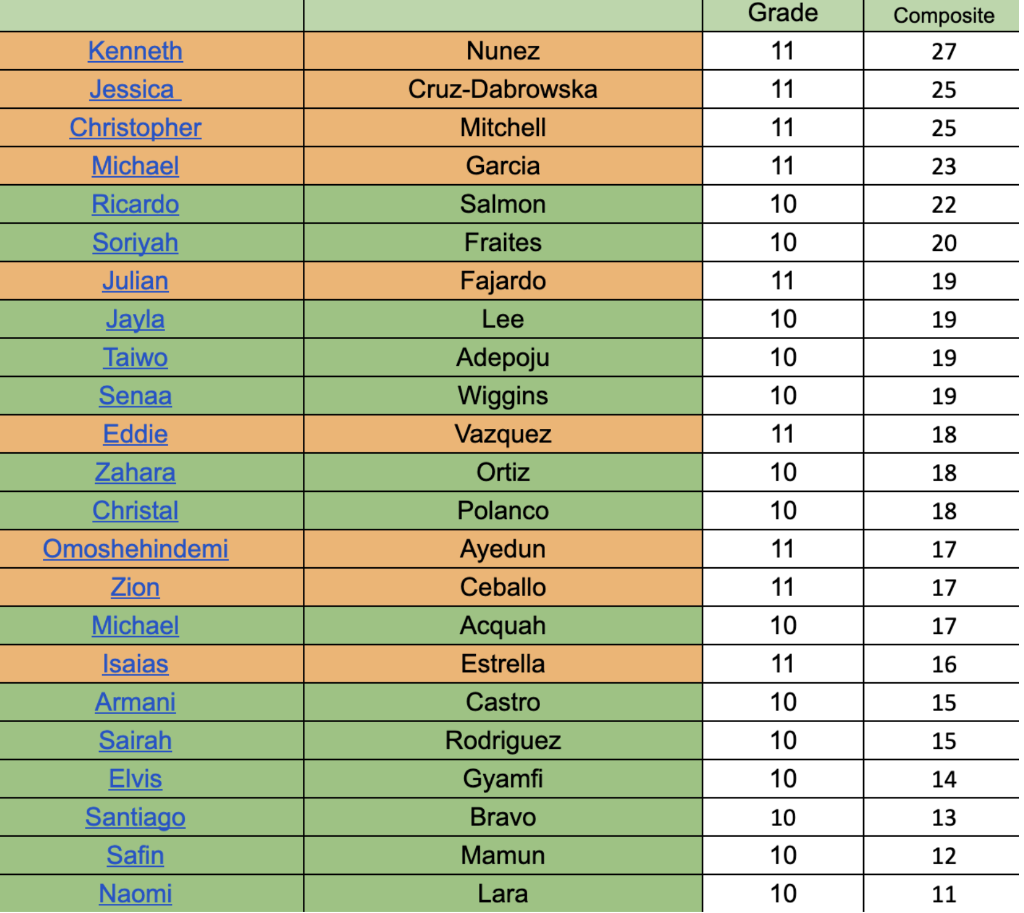
Current Top 10th & 11th Grade ACT Results — Highest composite score: 27
Current Top 10th & 11th Grade Testers:
- •Not a single student scored at a level that would qualify them for Ivy-level consideration
- •After the top three scores, performance drops sharply
- •By the 5th student, results are already far from required benchmarks
- •These are the highest-testing students in the school, not the average
Historical Context
These results are consistent with Comp Sci High's standardized testing history.
Achieving a 30+ or 32+ ACT score is academically comparable to earning multiple 5s on AP exams across subjects — something that has never happened in CSH history.
Yet our goal is not to do this once. Our goal is to do this for 10 students per grade, every year.
The Task with some Context
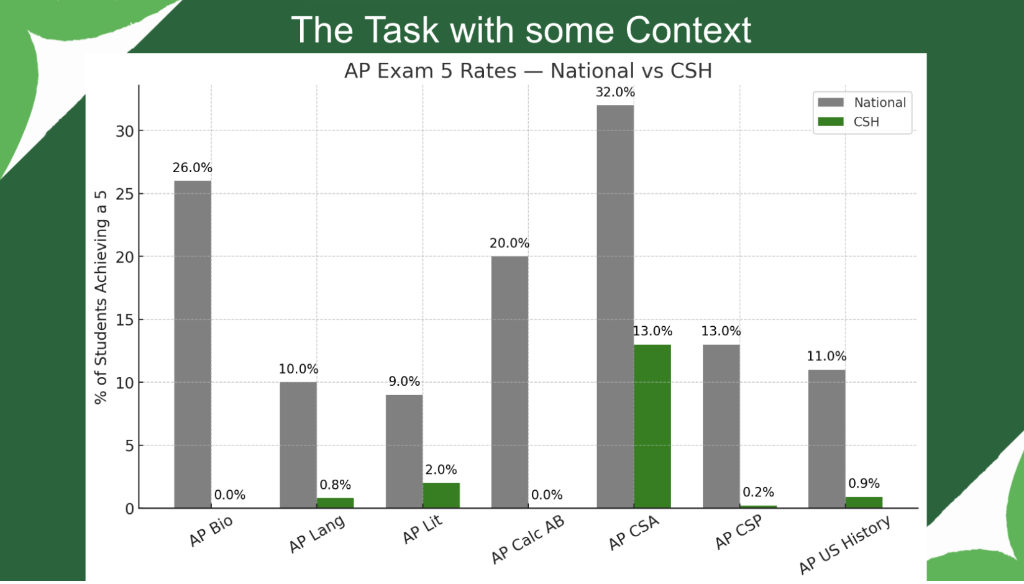
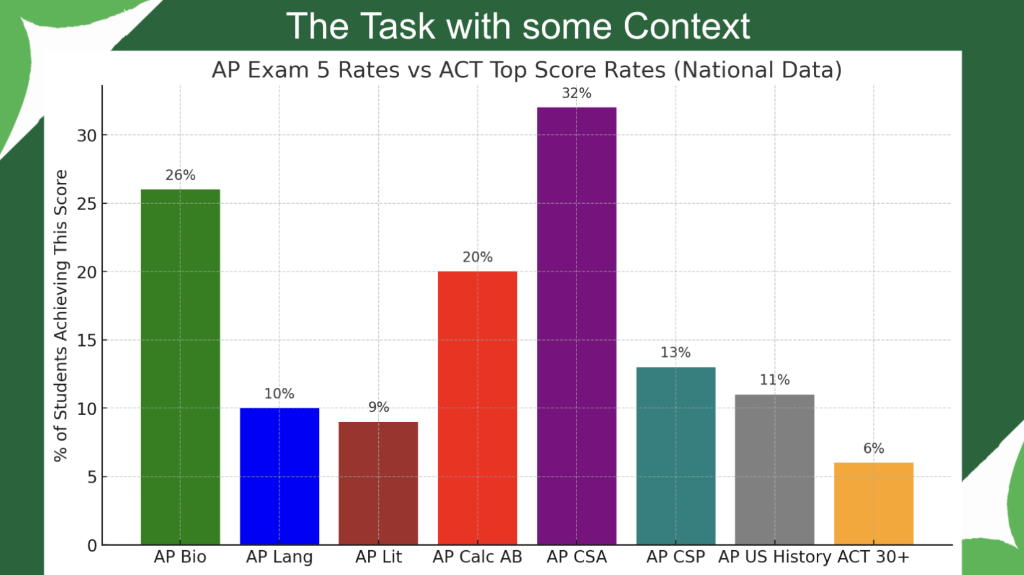
Programs like Bespoke — which were unable to generate meaningful results with our students — fail for two fundamental reasons:
1. Misunderstanding Academic Gaps
They do not understand the depth and variability of our students' academic gaps. Our students often have layered gaps in reading, writing, grammar, quantitative reasoning, and test fluency.
2. Underestimating Time Requirements
They underestimate the amount of time and repetition our students need. ACT success requires sustained, intensive instruction, not short-term exposure.
To Contextualize:
- An AP teacher typically provides 100–150 hours of instruction for a single subject exam
- The ACT tests four subjects
- Many assume a 30–40 hour prep course is sufficient. That assumption is false for our student population.
The Solution: Program Design
Expertise + Time + Targeted Instruction
A Dedicated ACT Expert Who:
- Knows the exam inside and out
- Understands how to level-set expectations with students
- Commits significant, sustained time to our program
Comprehensive Academic Skill-Building Including:
Critical Understanding:
This cannot be a bolt-on program. It must be structural, intensive, and respected.
This is NOT an "ACT-for-all" model
Participation must be targeted and aligned with students' postsecondary goals
Students will be:
- →Coached on ACT content
- →Simultaneously monitored and supported in their school-based academic performance
- →Explicitly taught academic skills they are not receiving in class but will be expected to have in selective college environments
8:00–9:30 AM — In-person ACT & Academic Skills class
Monday & Wednesday
Class during reading block
Monday & Wednesday
Small-group pull-outs (45 minutes)
Alternative: once-monthly 3-hour Saturday ACT session
Wednesday
Virtual Office Hours
Monday & Wednesday — 2 hours per day
Mix of required check-ins and open support
ACT-specific skills integrated with:
Reading Full Texts
Comprehensive reading comprehension development
Analytical Writing
Writing analytical and research papers
Grammar & Language
Grammar and language conventions mastery
Study Systems
For both school and standardized tests
Implementation & Accountability
Structure, oversight, and student selection
Bi-weekly meetings with the Director of Academic Programming to:
Four-Week Intensive ACT Bootcamp
Structured as two 2-week sessions
Participants Drawn From:
Top testers in 10th and 11th grade
Top academic performers
Approximately 15 students per grade
Key Policies:
Once a student earns a qualifying ACT score:
- ✓They exit ACT test prep
- ✓Remain in academic skill-building supports
- ✓Their seat opens for a student from the waitlist
Students earn course credit
The Clear Outcome
Students who complete this pipeline should be legitimately competitive for Ivy League institutions and top ten colleges and universities.
This is not branding.
This is intentional, data-driven access building, and it requires us to build something far stronger than what has existed before.